Tarot basics
Can you use tarot if you're not spiritual?
Yes. You don't need to believe the cards know anything. Here's how tarot works as a set of pictures to think with, where it actually came from, and how to start without any of the mysticism.
What is secular tarot?
Secular tarot is the practice of using tarot cards as pictures to think with, with no belief in fate, spirits or hidden forces required. You ask a question about yourself, draw a card, and use the images and traditional themes as a prompt for reflection. The card doesn't know anything. You do, and the card gives you a way in.
If that sounds too simple, it's worth remembering that people have used pictures to think for a very long time. A card with a figure walking away from eight cups, or a person resting on a stone tomb, gives your mind something to hold onto. Whatever comes up when you look at it was already somewhere in you. The card just helped it surface.
Where tarot actually came from
Tarot didn't start as a mystical tool. The earliest known decks were made in northern Italy in the fifteenth century as playing cards, used for a trick-taking game that's still played in parts of Europe today. The extra picture cards we now call the Major Arcana were trump cards in that game.
The link between tarot and the occult came much later. In late eighteenth-century France, a few writers began claiming the cards held ancient secret wisdom, and fortune-telling with tarot grew from there. The deck many people know best, with the familiar illustrated scenes on every card, was published in London in 1909 and drawn by the artist Pamela Colman Smith. So if you're skeptical of tarot's mystical claims, you're in good company: historians who study the cards have been, too.
How tarot works without belief
You don't need the cards to be magic for them to be useful. Here's what's actually happening in a reflective reading: you bring a question, you look at an image, and you read a few traditional themes connected to it. Then your mind does what minds do. It makes connections, notices what fits and what doesn't, and brings up feelings you hadn't put into words.
That's the whole idea behind reflective tarot. The randomness of the draw is part of what makes it work. You didn't pick the card, so it can catch you off guard and nudge your thinking somewhere new. It's a bit like opening a book of poems to a random page: the poem wasn't written for you, but you might still find a line that lands.
The card doesn't know your answer. It just gives you somewhere to look for it.
Questions that work for a skeptic
If you don't believe the cards can see the future, it makes sense to stop asking them about it. Questions about you and about now give a card something it can actually help with.
| Instead of | Try |
|---|---|
| What will happen with my job? | What do I want my work to feel like this year? |
| Is he the one? | What do I value most in this relationship? |
| Will this decision work out? | What am I hoping this decision will give me? |
| What's my destiny? | What do I keep coming back to, year after year? |
| What does the universe want me to know? | What have I been avoiding thinking about? |
You'll notice the rewrites don't need anything supernatural to make sense. They're the kind of questions a good friend or a journal prompt might ask. The card just makes them a little easier to sit with.
How the cards are traditionally read, without the mysticism
Each card comes with a set of themes passed down through the tarot tradition. You don't have to treat them as truths. Think of them as a shared vocabulary: a starting point that saves you from staring at a blank page.
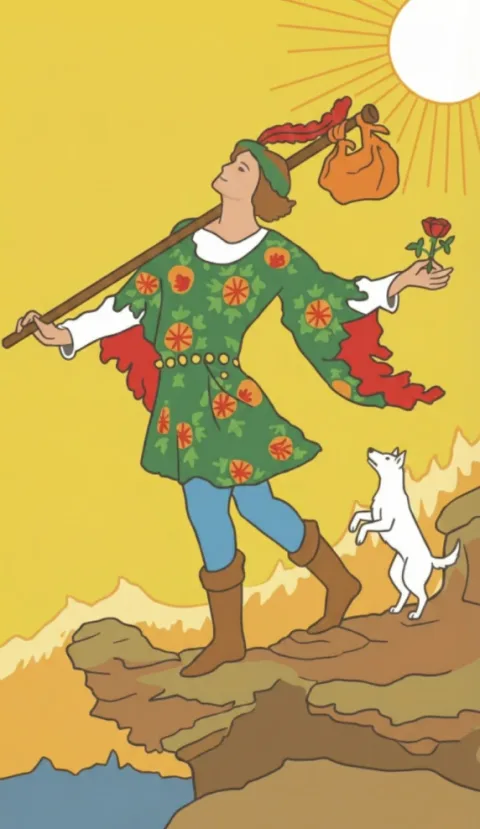 Card meaningThe FoolThe Fool — traditionally read as beginnings and a leap into the unknown. A prompt: where are you holding back from trying something new?
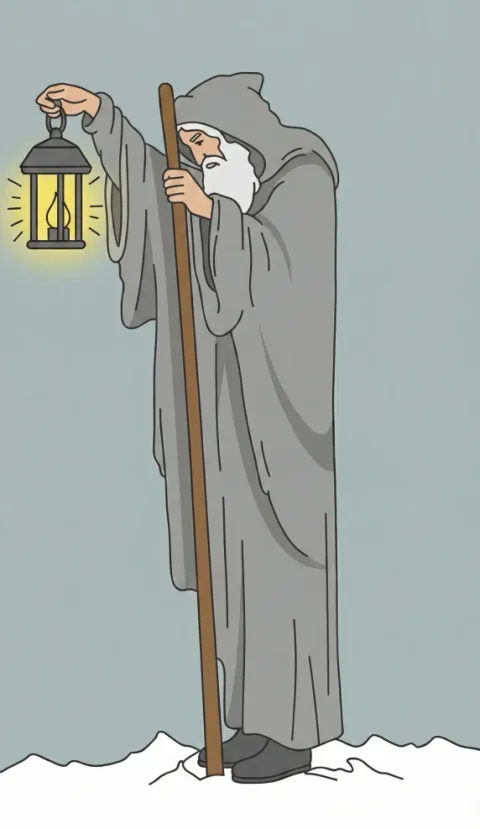
The Hermit is traditionally read as solitude and looking inward. For a skeptic, it might simply be a prompt to ask whether you've had any real quiet lately, and what you'd think about if you did.
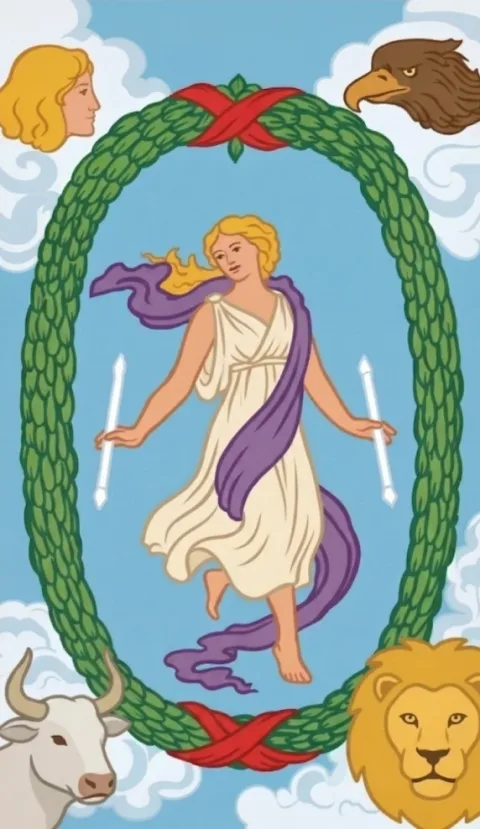 Card meaningThe WorldThe World — traditionally read as completion and a cycle coming to a close. A prompt: what have you finished recently that you haven't given yourself credit for?
The Minor Arcana work the same way. The Ten of Wands, traditionally read as carrying too much, rarely needs a mystical explanation to hit home. You can find every card's traditional reading on the card meanings pages.
A simple practice for skeptics
You don't need candles, crystals or a special cloth. A deck or a free online draw, a few minutes and something to write with are plenty.
- Write one question about you and about now. "What do I need this week?" works well to start.
- Note your mood. One word: tired, anxious, curious, flat.
- Draw one card. Look at the image for a few seconds before you read anything.
- Describe the picture. Who's there, what are they doing, how does it feel?
- Read how the card is traditionally read. One or two lines from its meaning page.
- Write what it brings up. The first thought, even if it seems unrelated or a little silly.
- Close it. You're not looking for a verdict, just one thing you noticed.
An example
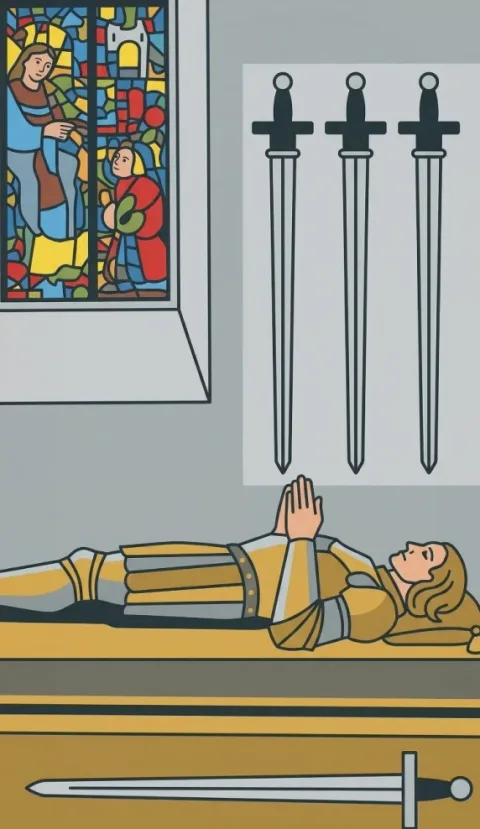
Say you've had a busy month and you ask, "What do I need this week?" You draw the Four of Swords, traditionally read as rest and recovery. The picture shows a figure lying still, hands folded, in a quiet room.
You don't believe the card knows you're tired. But looking at it, you notice your shoulders are up near your ears, and you realize you haven't had a single evening without your laptop in two weeks. You write: "flat · Four of Swords · I could take Wednesday night off." The card didn't tell you to rest. It just gave you a picture of resting, and you recognized yourself in it.
What your reaction can tell you
The most useful part of a reading is often the second after the card turns over. If you feel relief, disappointment or a little jolt of recognition, that reaction may tell you more than the card itself. It shows you what you were hoping for or worried about, before you had time to think it through.
If you keep a few notes, you might also start to see patterns: the same worry showing up week after week, or a card you keep reacting to strongly. None of that needs a spiritual explanation. It's just your own mind, written down, and it can be surprisingly clarifying to read back.
Where a card shouldn't be the one deciding
Whether you're spiritual or not, a card shouldn't be making your big decisions. For questions about your health, money, legal matters or safety, a reading can help you notice how you feel about a situation. The decision itself belongs with you and with someone qualified you trust.
That's true for everyday choices too. If a card seems to point one way and your own judgment points another, your judgment wins. The card was only ever a picture. You're the one who knows your life.
Try a secular tarot reading
Pick a question about you and about now, draw one card, and spend two minutes with it. You don't have to believe anything. Just notice what comes up.
Tarot Told Me is a reflective tarot app coming to iPhone and Android, built around the same idea: the cards are pictures to think with, and a reading starts with your question.
Frequently asked
Can you use tarot if you don't believe in it?
Yes. Many people use tarot purely as a self-reflection tool. You draw a card, read how it's traditionally interpreted, and notice what it brings up. No belief in fate or spirits is needed for that to be useful.
Is tarot a religion?
No. Tarot began as a set of playing cards in fifteenth-century Italy and isn't tied to any religion. Some people use it in spiritual practices, and others use it in a completely secular way, as a prompt for thinking and journaling.
Does tarot actually work?
There's no evidence that tarot can predict the future. What it can do is give you a structured, quiet moment to think about a question, with an image and some traditional themes to react to. Whether that helps depends on how you use it.
Is it okay to use tarot as an atheist or a skeptic?
Absolutely. Using tarot as a reflection tool doesn't require any belief. If anything, a skeptical approach can make readings clearer, because you stay focused on what you notice rather than on signs or predictions.
What's the difference between secular tarot and fortune-telling?
Fortune-telling treats the cards as a way to see what will happen. Secular tarot treats them as pictures to think with: you ask about yourself and the present, and the reading is about what you notice, not about the future.
Does Tarot Told Me use AI for readings?
The free tools on this site show how each card is traditionally read. In the app, personal readings are written by AI based on your question, your mood and the cards you drew, as a prompt for your own reflection rather than a prediction.
Sources
- M. Dummett — The Game of Tarot: From Ferrara to Salt Lake City (Duckworth, 1980)
- R. Decker, T. Depaulis, M. Dummett — A Wicked Pack of Cards: The Origins of the Occult Tarot (St. Martin's Press, 1996)
- R. Decker, M. Dummett — A History of the Occult Tarot, 1870–1970 (Duckworth, 2002)