Death
Meaning
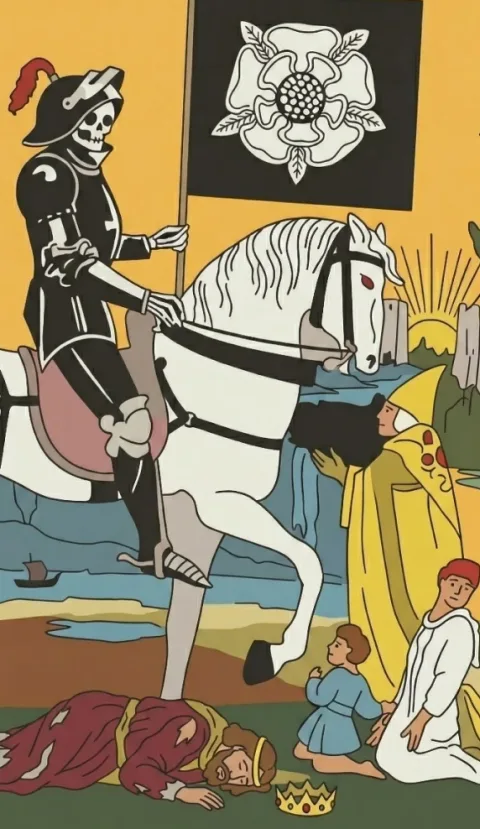
Death is card thirteen. The classic card shows a skeleton in black armor riding a white horse and carrying a black flag with a white rose. Before it, a king has fallen, while a child, a young woman, and a bishop respond in different ways. In the background the sun rises between two towers. The image is stark, but the rising sun matters: after the ending, a new day begins.
In a reading, Death isn’t read as a sign of physical death — traditionally, the card is about endings and change. It points to an ending that is necessary: a job, a relationship phase, a habit, or an old identity. Endings can hurt, and the card doesn’t pretend otherwise. What it offers is perspective. Holding on to what’s already over usually costs more than letting it go. The card asks you to grieve what you need to, then make room for what comes next.
Upright
Endings, transformation, transition, release, a fresh start. An invitation to let a chapter close so another can open.
Reversed
Resisting change, holding on, stagnation, fear of endings. A nudge to look at what you’re keeping alive out of habit and ask whether it still serves you.
In love
Traditionally, a card of major change in love. For singles it can mean leaving an old pattern behind; in a relationship it’s read as an ending of some kind, sometimes of the relationship and sometimes of an old way of relating that makes room for a deeper one.
Career and money
Traditionally, it points to something in your work finishing, such as a role, a project, or a way of doing things. It’s a good moment to let go of what no longer fits and prepare for a different direction.
As advice
Let go of what’s already over. Give yourself time to grieve it, then turn toward what’s next.
Frequently asked
Is Death a yes or no card?
Traditionally, mostly no — Death is read as an ending, so for keeping things as they are the traditional answer is no. If the question is about change or a fresh start, it can point the other way.
What does Death mean upright?
Endings, transformation, transition, release, a fresh start. An invitation to let a chapter close so another can open.
What does Death mean reversed?
Resisting change, holding on, stagnation, fear of endings. A nudge to look at what you’re keeping alive out of habit and ask whether it still serves you.
What does Death mean in love?
Traditionally, a card of major change in love. For singles it can mean leaving an old pattern behind; in a relationship it’s read as an ending of some kind, sometimes of the relationship and sometimes of an old way of relating that makes room for a deeper one.
What does Death mean for career and money?
Traditionally, it points to something in your work finishing, such as a role, a project, or a way of doing things. It’s a good moment to let go of what no longer fits and prepare for a different direction.
What does Death mean as advice?
Let go of what’s already over. Give yourself time to grieve it, then turn toward what’s next.
What comes before and after Death?
The Hanged Man comes before Death, and Temperance comes after it. The pause of The Hanged Man leads to a real ending here, and Temperance follows with healing and balance.
Does the Death card mean someone will die?
No. In tarot, Death is a symbol of endings and transformation, not a sign of physical death. It’s one of the most misunderstood cards in the deck.
Which astrological and elemental associations does Death have?
In tarot tradition, Death is linked to Scorpio and the element of Water. These are historical associations, not claims about you.
Is Death your birth card? Calculate it →
Is Death your year card? Find out →